Hizbullah's documents: from the 1985 Open letter to the 2009 Manifesto
Hizbullah's documents: from the 1985 Open letter to the 2009 Manifesto
Hizbullah's documents: from the 1985 Open letter to the 2009 Manifesto
Key takeaways
Bibliography: Alagha, J.E., 2011. Hizbullah’s documents: from the 1985 Open letter to the 2009 Manifesto. Pallas Publications, Amsterdam.
Authors:: Joseph Elie Alagha
Collections:: Arab-Israeli Conflict
First-page:
Abstract
Citations
content: "@alaghaHizbullahDocuments19852011" -file:@alaghaHizbullahDocuments19852011
Reading notes
- Whoever takes Allah, His Apostle and those who believe as their friends, that Allah's party (Hizbullah) is indeed the triumphant'' (5:56)
- To the leader who confided in and trusted his people and led them in jihad [Shaykh Raghib Harb].
- Therefore, we in Lebanon are neither a closed organizational party nor a narrow political framework. Rather, we are an Umma tied to the Muslims in every part of the world by a strong ideological-doctrinal and political bond, namely, Islam
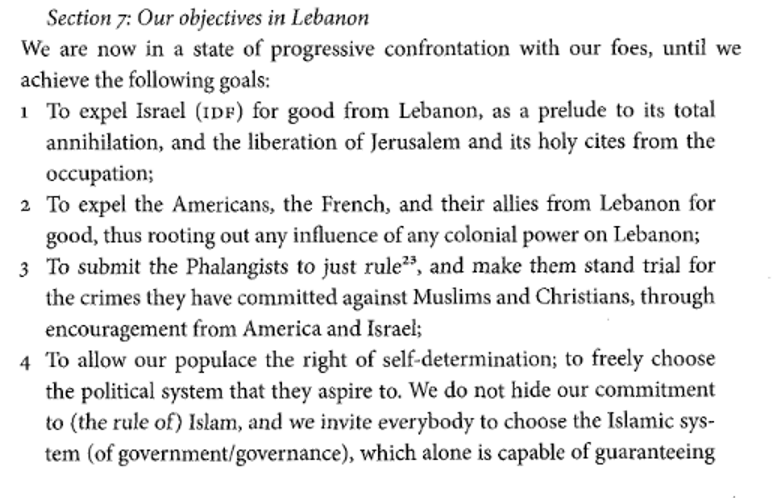
- We do not want to impose Islam on anyone, we do not want Islam to govern Lebanon by force, as political Marianism is governing now.
- The existing regime is a product of world arrogance that is adversary to Islam
- Whoever does not judge according to what Allah has revealed, those are the evildoers!
- The policies of the leaders of the Marionets cannot achieve peace in Lebanon due to them being based on tribal blood ties, sectarian privileges, and alliances with colonial powers, and with Israel
- Both America and the USSR have failed, capitalism and communism have failed
- Concerning Lebanon and Palestine, we are primarily concerned with facing America and Israel
- We reject camp David and all deals that seek to legitimise Zionism
- Worth noting that the Islamic résistance is compiled of men, women, children, and the elderly
- Those Arab regimes that seek to reconcile with Israel only do so because they were birthed from the same colonial regimes that birthed Israel
- Colonialism was not able to reach the material conditions of the Arab world until after the divisions broke out between Sunnis and Shias